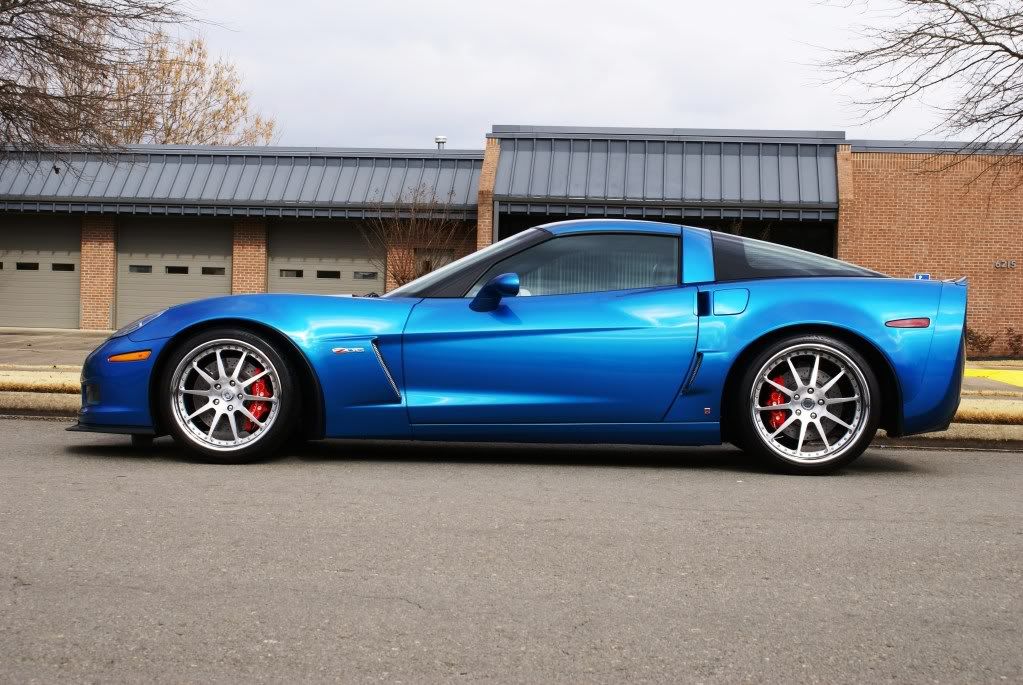
Latest scoop on the next vette:
General Motors announced it will begin production of the C7 Corvette sports car in April of 2012 in advance of a scheduled launch as a 2013 model. The announcement was made as part of GM’s two-year product plan for its four core brands – Chevrolet, Buick, Cadillac and GMC.
This news brings the C7 to market a full year earlier that expected. The next generation Corvette was originally scheduled for a 2014 launch. It seems the General Motors, emerging from bankruptcy, is anxious to capitalize on the interest that is always created by the arrival of a new generation Corvette, and in this case, on the 60th Anniversary of Corvette.
The C7 Corvette is likely to have a smaller, lighter body using more lightweight materials such as carbon fiber, aluminum and magnesium.
The new Corvette may even include a smaller, yet more efficient engine, but with its lighter body it should retain the necessary power-to-weight ratio demanded from Corvette owners. It's nearly impossible to imagine a Corvette without a V8, but some interesting options are on the table. A twin-turbo V6 is a very strong possibility," A twin-turbo version of the direct-injection 3.6-liter DOHC V6 that's currently in the Cadillac CTS could easily pump out 400 hp, just short of today's 430hp LS3 V8.
While there very well could be a V6 as the base engine, a pushrod V8 will certainly be a part of the plan as it is part of the Corvette Tradition . In light of new fuel economy restrictions from the Obama administration, the displacement will certainly be down from today's 6.2-liter and 7.0-liter engine sizes, to between 5.0- and 5.7-liter. Turbocharging and variable valve timing are distinct possibilities to make those smaller V8s comparable with today's V8. A dual-clutch gearbox is also not out of the question either if GM wants to keep up with the Porsche 911 or even the Nissan GT-R. It's still too early to know exactly what the powertrain lineup will look like, but expect three levels of performance similar to today's, base model, Z06 and ZR1. Yes, the ZR1 could live on as a C7.
To sum it up, all this also means that the Corvette design and engineering team will now have the resources and the corporate blessing to move full speed ahead on a new Corvette that could see changes to America's sports car that include a smaller, lighter body, greater use of advanced weight-saving materials like carbon fiber, aluminum and magnesium and perhaps a smaller engine but one that will still provide the power-to-weight ratio that Corvette owners have become accustomed to.
At the NCM's C5-C6 Birthday Bash in April of this year, Corvette Chief Engineer Tadge Juechter reassured the Corvette owners present that the team is always thinking about the next generation Corvette and how to make it better. Now that the mid-engine layout has once again been tossed aside, Tadge's engineering team will have essentially just a couple of years to make these engineering decisions and test them in mules which we could see as early as 2011.
Styling-wise, the car could look similar to that of the Corvette Stingray Concept that appeared at the Chicago Motor Show this year. However, in today's economy, a complete retooling of the Bowling Green plant would be very expensive ( one reason the mid-engine design was ruled out ). We believe the new C7 will be more of a transition and refinement of the C6 body style. It may be though, that the design team will see that owners would accept more of a radical departure from the looks of the C5 and C6.
GM's VP of Global Design Ed Welburn told Inside Line that the design of the new C7 Corvette will go retro much like the new Camaro and a prominent design feature will be the return of the split rear window. The next generation Corvette is expected to be launched in 2012 as a 2013 model.
The original split window appeared on the 1963 Corvette Coupe, but Chief Engineer Zora Arkus-Duntov hated the feature due to its limited visibility and in 1964 it was removed. Welburn addresses the visibility issue by saying "With the back-up cameras and blind-spot detection systems that we have these days, the visibility issue is much less of a problem."
The Corvette Stingray Concept that appeared in the latest Transformers movie also has a split rear window. "That car is not the next Corvette." says Welburn, "But the split-window is something that I expect for the next Corvette."
Welburn was the driving force behind the new reborn Camaro and is a big fan of the Corvette Stingray concept design as evidenced in this previously released Stingray Concept Introduction video.
As stated earlier, Inside Line says the C7 Corvette will have the traditional front-engine, rear drive layout.
Sources: Inside Line and Corvetteblogger.com
Love my camaro but it can't begin to compete with this: